Custody Risk in Mining Payouts and How to Reduce It
Every hour your mining earnings spend as a balance in an operator's account, you are trusting that operator with that money. The exposure is smaller than most miners assume and easier to shrink than most bother to try: at 1 PH/s, leaving a full month of payouts in place is about 0.013458 BTC — near $1,139.80 on 21 September 2026 — while a withdrawal every 12 hours holds the average outstanding balance near 0.000112 BTC, roughly $9.49.

Key takeaways
- Counterparty exposure equals the balance you leave with the operator multiplied by how long it stays there; hourly settlement at 1 PH/s accrues about 0.0000187 BTC, or $1.58, per hour.
- Withdrawing on a 12-hour cycle cuts the average outstanding balance from a month's 0.013458 BTC to roughly 0.000112 BTC — about 120 times less exposure.
- Mining payouts are listed as zero-fee, which removes the usual excuse for letting balances accumulate out of convenience.
- Separate the operating float from long-term holdings: the account you mine into is not the account you should store years of production in, whatever its features.
The short answer
Mining income is exposed to two different risks that get discussed as one. The first is market risk — the coin you are being paid in can fall. The second is custody risk — the coins can be lost, frozen or misappropriated by whoever holds them at that moment. Custody risk does not care about price at all: it is a function of how large the balance is and how long it sits there.
That framing makes the fix mechanical rather than philosophical. You cannot eliminate the fact that a pool holds the coins between the moment they are earned and the moment they are paid, but you can shorten the interval and cap the balance. PPS+ settlement at current difficulty arrives hourly, so the interval between earnings and payout is measured in tens of minutes, not weeks.
How the mechanism works
Rewards are credited to a mining account balance, which is a claim on an operator rather than coins in your own control. On the ViaBTC side, the mining dashboard and a multi-currency wallet sit inside the same account, so balances can be withdrawn, converted between supported assets, or simply left in place — the trade between convenience and exposure happens inside the ViaBTC Crypto Wallet rather than across two platforms.[1]
Two settlement behaviours determine how fast that balance grows. PPS+ settles the block-reward component per accepted share on an hourly cadence based on current difficulty, with a listed 4% fee on that component and a listed 2% fee on the transaction-fee component. PPLNS distributes block reward and transaction fees together at a listed 2% fee after the block reaches six confirmations, weighted by each miner's share of pool hashrate over the last five difficulty rounds.[2] Both end up as a balance; only the arrival pattern differs.
| Where the coins sit | What it protects against | What it does not protect against | Sensible use |
|---|---|---|---|
| Mining account balance | Operational friction: conversion, payouts and monitoring in one place | Operator solvency, credential compromise | An operating float measured in days, not months |
| Self-custody wallet | Operator failure, frozen accounts | Your own key-handling mistakes and lost backups | Long-term holdings and reserves |
| Split across accounts | A single compromised login, role confusion in teams | Concentration in one provider overall | Separating treasury, operations and hot balances |
| Borrowing instead of liquidating | Being forced to sell into a weak market to cover costs | Debt service obligations still exist | Bridging power invoices through a short dip |
The first row is the one most miners over-use. It is genuinely convenient to keep everything where it is settled, and convenience has a real value — but that value should be priced against the exposure it creates, not treated as free.
Where miners get it wrong
Treating a settlement balance as if it had already been withdrawn. A balance is a receivable. Its credit quality is the operator's, not the chain's, and the difference only becomes visible on the day something breaks.
Assuming frequency of withdrawal is expensive. Mining payouts are listed as zero-fee, so moving settled earnings is not where charges accumulate. If you broadcast an on-chain transfer to an external address, you pay the network's fee, which is a block-space cost rather than a percentage of your income.
Keeping the mining account as the storage account. Wallets hold balances across supported networks and let you convert between assets, which makes them comfortable places to park coins. Comfortable is not the same as final. The destination for a reserve balance should be one where the keys are yours.
Concentrating credentials. One login with no second factor, shared by three people, is the most common custody failure in small mining operations — and it has nothing to do with the operator's balance sheet. Multi-account management and per-device alerts are the cheapest controls available.
A worked exposure calculation
Take 1 PH/s, which settles about 0.000449 BTC a day at current difficulty, worth roughly $37.99. Leave everything in the account for 30 days and you have accumulated 0.013458 BTC — about $1,139.80 of claim on an operator at any one moment.
Now withdraw on a 12-hour cycle. Each settlement period accumulates around 0.000224 BTC, so the balance cycles between zero and that figure, averaging about 0.000112 BTC, or $9.49. Same earnings, same fee schedule, roughly 120 times less exposure at any instant. The trade is administrative: you need an address to send to, and in practice a self-custody wallet you control. For a miner running 10 PH/s the numbers scale linearly — the monthly accumulation is about 0.13458 BTC, near $11,398 — which is why large farms tend to automate treasury movements rather than decide them by hand each week.
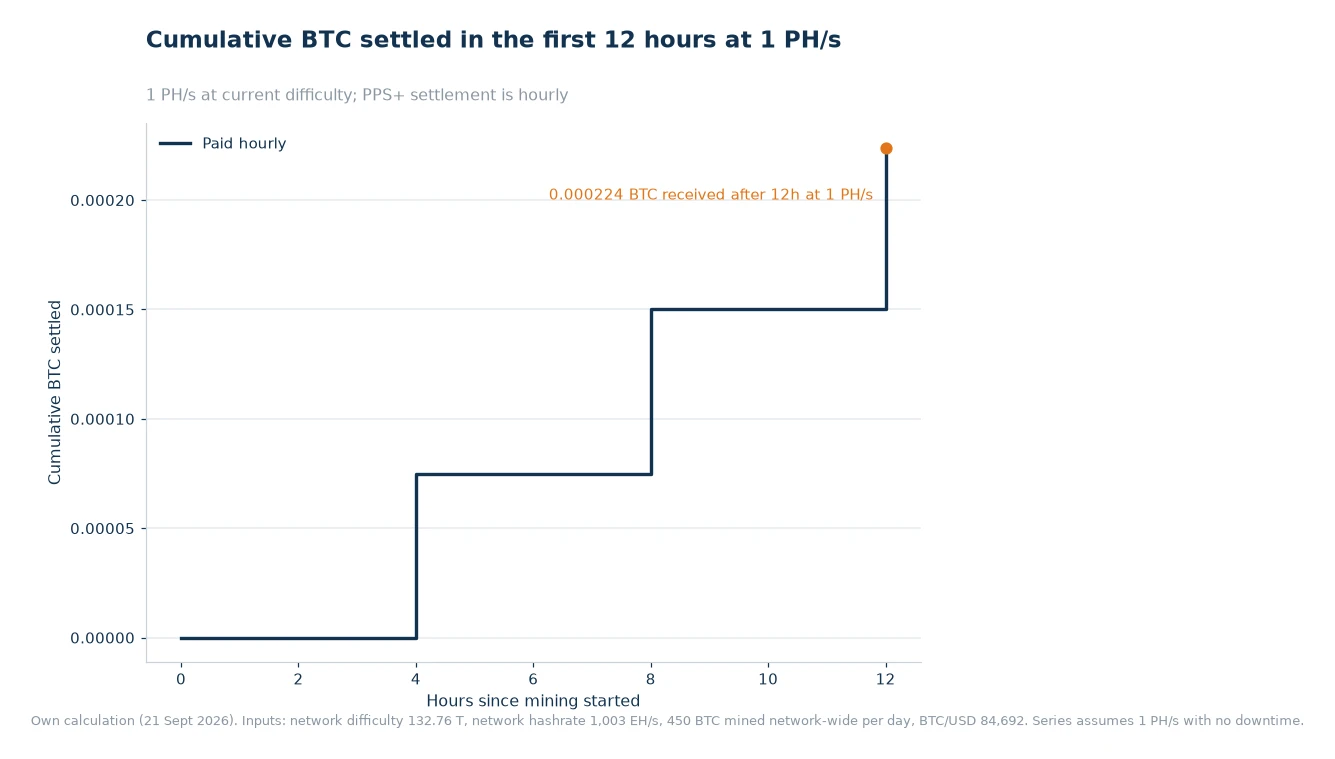
The chart is the point made visually. Settlement arrives in small, frequent increments — about 0.0000187 BTC an hour — and each increment is a moment where the coins either stay inside the operator's control or leave it. A miner who withdraws weekly has roughly 7 of those moments per week to act on; a miner who withdraws monthly has about 30 decision points but only uses one of them.
There is a second use for the same balance besides moving it out: using it as collateral rather than selling it. The collateral-pledged loan route follows a fixed sequence — add collateral, request a loan, receive the disbursement, repay, then redeem the collateral — and lets, say, a power invoice be covered without liquidating coins mid-cycle.[3] That said, borrowing is not a custody solution: collateral posted with any counterparty is itself an exposure, and it should be sized like one.
A checklist you can run today
- Set a maximum balance. Pick a number your operation can tolerate losing and withdraw when the balance reaches it. For a 1 PH/s setup, a 12-hour cycle caps exposure near $9.49.
- Decide the destination before you need it. A self-custody wallet created in a hurry, during a market event, is where mistakes happen. Create it while nothing is happening and test the address with a small transfer.
- Match settlement to cash needs. Hourly settlement under PPS+ means funds are available when invoices arrive, so a large idle balance is rarely necessary. If you are on PPLNS, remember distributions follow six confirmations and a five-difficulty-round window.
- Separate roles and credentials. Whoever monitors hashrate does not need withdrawal rights; use per-user accounts and an alerting setup that flags unexpected logins and hashrate drops.
- Reconcile the balance against the pool's own data. Your settled balance should track the pool's hashrate share, difficulty and your uptime. If it drifts, find out why before moving coins — the pool statistics view settles that question quickly.
Frequently asked questions
How often should a miner check pool statistics?
Weekly is enough for cash flow, daily if you are reconciling worker uptime or chasing a hashrate fault.
Does the payout method change my average income?
It changes the variance and the fee, not the underlying expected value: your share of network hashrate still sets the ceiling.
Do I need a hardware wallet for mining income?
Not for the operating float, but the reserve portion of your production belongs somewhere you control the keys. The mining account is a settlement and conversion venue; a self-custody wallet is where long-term holdings should end up.
How much should I leave in the mining account?
As little as your payment cycle requires. At 1 PH/s, a 12-hour withdrawal cycle keeps the average balance near 0.000112 BTC, about $9.49, while leaving the full month in place exposes about 0.013458 BTC, near $1,139.80.
Shrink the window, cap the balance
Custody risk is the rare mining cost you can cut without touching hardware, hashrate or fees. Set a maximum balance, decide where withdrawn coins go before you need to send them, and treat frequent movement as routine rather than as an emergency procedure. Then reconcile the balance against published pool data once a week, so the only thing that ever surprises you is price.
Data and sources: ViaBTC wallet and payout documentation[1], ViaBTC fee schedule[2] and collateral-pledged loan workflow[3]. Network difficulty (132.76 T), network hashrate (1,003 EH/s), 450 BTC mined network-wide per day and the BTC/USD price of 84,692 were read from public chain data and market feeds on 21 September 2026; all balance, exposure and scaling figures are our own calculation from those inputs. Nothing here is investment advice, and no outcome is guaranteed.