A Closer Look at Writing a Machinery Sourcing Specification
A machinery sourcing specification should describe how the equipment will be used, what output it must deliver, how it connects to the line, and what evidence proves acceptance. Safety, installation, training, documents, and service also affect the purchase. Define these requirements before comparing supplier quotations.
Key takeaways
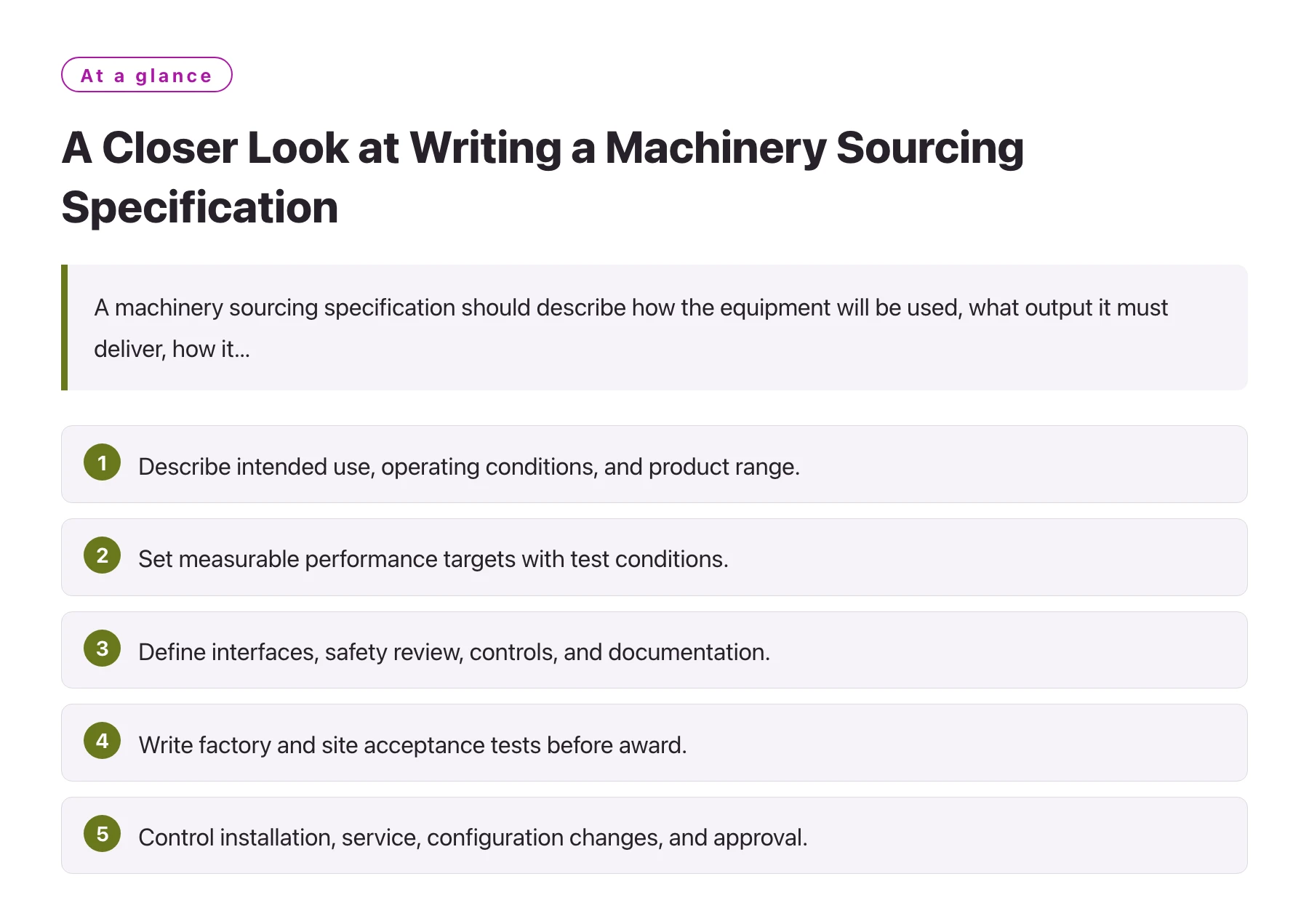
- Describe intended use, operating conditions, and product range.
- Set measurable performance targets with test conditions.
- Define interfaces, safety review, controls, and documentation.
- Write factory and site acceptance tests before award.
- Control installation, service, configuration changes, and approval.
A useful machine specification lets different suppliers price and test the same operating requirement.
1. Define the machine and its intended use
Describe machine type, process, materials handled, output, duty cycle, operators, workplace, installation environment, and expected service life. State whether it is a stand-alone machine, production line, replacement unit, or retrofit. Identify utilities, floor space, access, and interface boundaries.
List normal use, setup, cleaning, maintenance, foreseeable misuse, and user skill assumptions. The intended use can change safety and performance needs, so do not ask suppliers to infer it from a short product name.
2. State capacity and performance requirements
Define throughput, cycle time, accuracy, repeatability, changeover, operating range, load, and acceptable downtime using consistent units and a test condition. Say whether targets apply continuously, to a batch, or only under ideal conditions.
Specify what evidence demonstrates capacity: factory acceptance test, sample production, measurement report, or defined run time. Include product, material, tooling, operator, environment, and test setup so results can be reproduced.
3. Describe the product and process interfaces
List workpiece sizes, material properties, incoming variation, fixtures, tooling, upstream and downstream equipment, conveyors, software, network, power, compressed air, and extraction. Identify which party supplies each connection and the design boundary.
Provide drawings, sample parts, expected tolerances, and process sequence. Ask vendors to identify assumptions, exclusions, and compatibility risks before pricing. A machine that meets a stand-alone capacity may not integrate with the buyer’s actual line.
4. Include safety requirements and risk review
Identify hazards connected with operation, movement, ejection, heat, pressure, electricity, noise, dust, access, cleaning, setup, and maintenance. Assign a qualified machinery-safety owner to determine applicable laws, standards, risk assessment, safeguarding, interlocks, emergency functions, instructions, and validation.
ISO 12100:2010 sets general principles and a methodology for machinery safety risk assessment and risk reduction. Use the applicable current standards and destination-market rules with qualified specialists; a cited general standard does not by itself certify a machine or cover every hazard. [1]
Ask the supplier to document residual risks and required user measures after design safeguards. Record any special competence, protective equipment, exclusion zone, or maintenance lockout needed. Have safety-critical decisions reviewed by people qualified for the machine and destination.
5. Specify controls, data, and documentation
List control architecture, operator interface, language, recipes, alarms, access levels, backups, cybersecurity expectations, data interfaces, and reporting needed by the facility. Identify software licenses, updates, and source or configuration records required by the contract.
Request electrical and pneumatic drawings, manuals, maintenance schedules, spare-parts lists, lubrication points, and troubleshooting information in agreed formats and languages. Define which documents are needed before shipment, installation, and training.
6. Set acceptance tests before purchase
Write factory and site acceptance tests with conditions, products, tooling, duration, throughput, accuracy, repeatability, alarms, safety functions, utilities, measurement equipment, sample size, and pass limits. State who witnesses, records, and signs results.
Separate design review, factory acceptance, installation checks, performance qualification, and operator training. Define how a failed test is corrected and retested, and who may accept a deviation. A supplier’s standard demonstration may not prove contract requirements.
Plan a representative run using the buyer’s part and production conditions. Agree who provides sample material, how setup is recorded, and whether the test can be repeated after adjustments. Preserve the results and configuration as part of the machine file.
7. Detail installation, service, and spares
Specify footprint, foundation, anchor points, lifting, shipping splits, assembly, leveling, commissioning, training, utilities, environmental conditions, and required site preparation. Identify buyer-supplied work and supplier responsibilities.
Set warranty start, response time, remote support, service visits, spare-part availability, consumables, and end-of-life support. Compare total ownership costs such as tooling, energy, maintenance, filters, software, and operator training rather than purchase price alone.
Confirm availability of critical spare parts and whether standard components can be sourced locally. Identify recommended spare quantities for commissioning and routine maintenance and include item codes in the offer. Define who trains operators and maintenance staff before handover.
8. Control supplier evidence and changes
Request references for similar machines, producing site, subcontractors, component suppliers, service network, capacity, and technical support. Review evidence for the exact proposed configuration and name the responsible integrator when several vendors contribute.
Require approval before changes to drive, guard, PLC, sensors, materials, software, factory, or critical subcontractor. Reassess safety, performance, acceptance tests, documentation, cost, and schedule when the configuration changes.
9. Issue a usable specification package
Combine requirement, method, limit, evidence, responsible reviewer, and approval status in one controlled file. Separate mandatory requirements from preferences. Provide revision history and a supplier response matrix that requires confirmation, exception, or evidence for each line.
Buyers comparing JS Sourcing machinery sourcing can use this package to align quotations, supplier capability, sample or run-off tests, installation, and quality checks before award.
Sources
Frequently asked questions
What belongs in a machinery sourcing specification?
Include intended use, capacity, product interfaces, safety requirements, controls, acceptance tests, installation, training, service, documents, and changes.
Does a capacity claim prove a machine meets the requirement?
No. Define a repeatable test with the product, tooling, setup, duration, measurement, and pass criteria.
Who should set machine safety requirements?
A qualified machinery-safety and compliance owner should identify applicable hazards, regulations, standards, and safeguards.
When should acceptance tests be written?
Before supplier selection so quotations, designs, and test costs can be compared against the same requirements.